
Research sponsored by the Office of Biological and Environmental Research within the U.S. Department of Energy’s Office of Science.

The NGEE project is a collaboration among scientists and engineers at Oak Ridge National Laboratory, Los Alamos National Laboratory, Brookhaven National Laboratory, Lawrence Berkeley National Laboratory, University of Alaska Fairbanks and our partners at leading universities and other state and federal agencies. ORNL is managed by UT-Battelle, LLC.

Project Summary

"...improving climate model predictions through advanced understanding of coupled processes in Arctic terrestrial ecosystems."

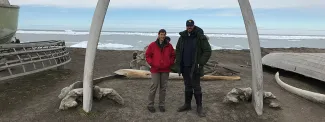
Increasing our confidence in climate projections for high-latitude regions of the world will require a coordinated set of investigations that target improved process understanding and model representation of important ecosystem-climate feedbacks. The Next-Generation Ecosystem Experiments (NGEE Arctic) seeks to address this challenge by quantifying the physical, chemical, and biological behavior of terrestrial ecosystems in Alaska. Initial research will focus on the highly dynamic landscapes of the North Slope (Barrow, Alaska) where thaw lakes, drained thaw lake basins, and ice-rich polygonal ground offer distinct land units for investigation and modeling. A focus on scaling based on investigations within these geomorphological units will allow us to deliver a process-rich ecosystem model, extending from bedrock to the top of the vegetative canopy, in which the evolution of Arctic ecosystems in a changing climate can be modeled at the scale of a high resolution Earth System Model grid cell (i.e., 30x30 km grid size). This vision includes mechanistic studies in the field and in the laboratory; modeling of critical and interrelated water, nitrogen, carbon, and energy dynamics; and characterization of important interactions from molecular to landscape scales that drive feedbacks to the climate system.

Sponsor-approved NGEE Arctic logo
A sponsor-approved logo is now available for the NGEE Arctic project. The logo reflects the strong interaction that exists within the team in areas of experiments, observations, and models.

Click to download

NGEE Arctic brochure highlights project goals of advancing predictive understanding of the structure and function of Arctic terrestrial ecosystems in response to climate change. Click to download..

Stan Wullschleger at the DOE JGI 2012 Genomics of Energy & Environment Meeting - March 2012

See Video Presentation on "Omics in the Arctic: Genome-enabled Contributions to Carbon Cycle Research in High-Latitude Ecosystems" http://www.scivee.tv/node/48004

Safety Training Requirements -- New March 18, 2013

NGEE-Arctic participants and collaborators must complete the required viewing of safety videos and reading of safety manuals to be approved for field and laboratory work at NGEE-Arctic facilities in Barrow, Alaska.

Participants and collaborators are strongly encouraged to complete all training requirements prior to travel because computers and internet connectivity are limited in Barrow.

Training materials are only available on the NGEE-Arctic project website (https://ngee-arctic.ornl.gov/content/ngee-safety).

Access to training materials requires NGEE-Arctic website login. After login, the Safety tab will appear.

  • ORNL participants may access Training Materials with their ORNL UCAMS login UID and PWD.
  • Other participants and collaborators may access Training Materials with their website UID and PWD.
    • If you are not a registered website user, please request an account (Login tab). You will receive e-mail notification with your account information.
    • Note that it may take 24 to 48 hours for your account to be established.

Upon successful completion of the training requirements you will receive e-mail notification from NGEE-Arctic Management that you are approved for field and laboratory work at the NGEE-Arctic facilities in Barrow.

NGEE Arctic scientists explore subsurface properties using geophysical techniques

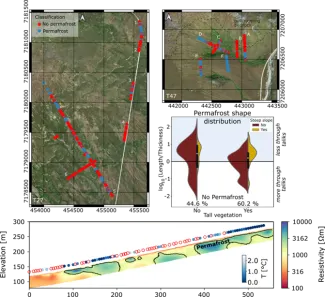
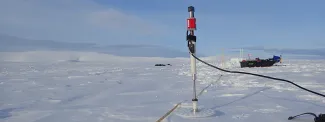
Susan Hubbard, task leader for the NGEE Arctic Geophysical Characterization team, talks about her experiences working in Barrow, Alaska. Susan and others from Lawrence Berkeley National Laboratory, Oak Ridge National Laboratory, and the University of Alaska Fairbanks spent weeks studying Arctic permafrost on the Barrow Environmental Observatory (BEO) in 2011 and 2012. Their results are beginning to reveal subsurface properties across tundra landscapes and provide high-resolution imagery of ice-wedge distribution which will be used to parameterize fine-scale models of polygons.

http://www.pnas.org/content/110/17/6611.full


Photosynthetic characterization of Arctic plant functional types

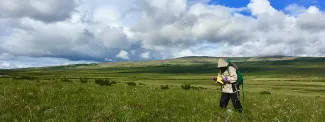
Alistair Rogers, a plant physiologist at Brookhaven National Laboratory, is working to improve the representation of leaf gas exchange for key Arctic plant species. In 2012, he measured the response of photosynthesis to internal CO2 concentration in two sedges, a grass, and a forb growing on the Barrow Environmental Observatory, Barrow, AK. The results of this work have implications for the carbon balance of Arctic ecosystems and suggest that the physiological characterization of a more extensive list of plant functional types is needed for the refinement of Earth System Models.

Photosynthetic characterization of Arctic plant functional types

NGEE Blog Site

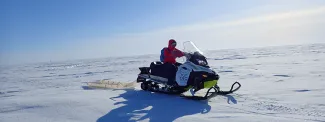
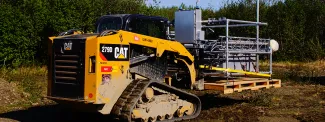
The 2013 field season in Barrow, Alaska began with a highly successful trip lead by David Graham and others from Oak Ridge National Laboratory, Lawrence Berkeley National Laboratory, and the University of Alaska Fairbanks. Read about their trip as they describe the collection of permafrost cores using a sled-mounted hydraulic drill rig.
 
“Photo Credit: David Graham, ORNL”

Follow trip

Project Updates

  • Quantifying and relating land-surface and subsurface variability in permafrost environments using LiDAR and surface geophysical datasets - more info..
  • Remote Monitoring of Freeze–Thaw Transitions in Arctic Soils Using the Complex Resistivity Method - more info..
  • Quarterly Report March 31, 2013 - more info..
  • Quarterly Report December 31, 2012 - more info..
  • LBNL modelers publish model that links microbiology and nitrogen dynamics: Trait-based representation of biological nitrification: model development, testing, and predicted community composition - more info..
  • Quarterly Report September 30, 2012 - more info..